Red-Eyed Tree Frog
Agalychnis callidryas
Updated: September 2025
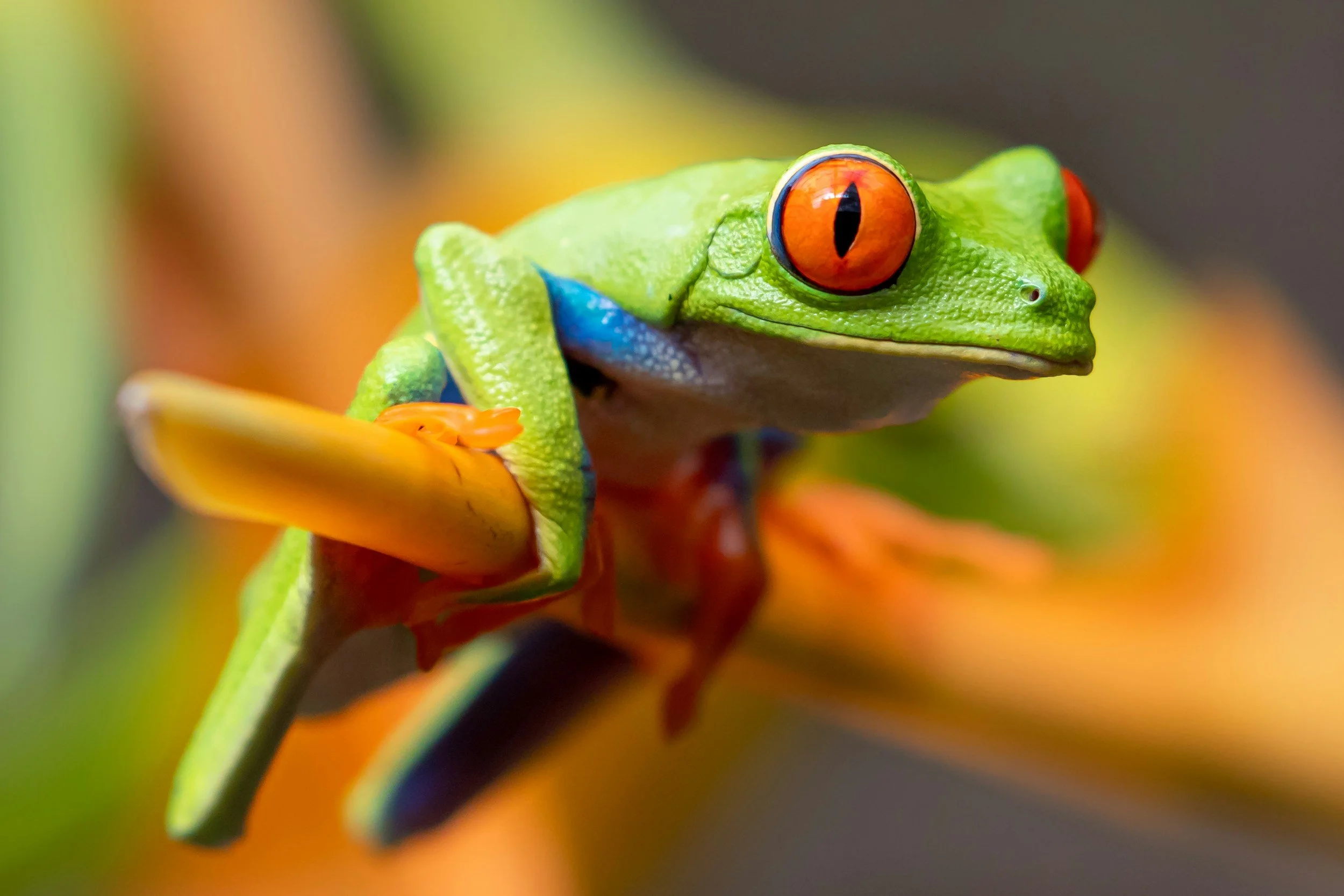
Quick Facts
Common name: Red-Eyed Tree Frog
Scientific: Agalychnis callidryas
Type: Arboreal, nocturnal/crepuscular
Adult size: ♂ ~2–2.5" SVL; ♀ up to ~3"+ (body length)
Lifespan: ~8–10+ years reported in captivity
Temperament: Skittish; hands-off pet (delicate skin)
Adult enclosure: Tall, front-opening; minimum 18×18×24" for 1–2 (more space per frog)
Temperature: Day ambient ~72–78°F with a warm perch/leaf ~84–85°F; night ~66–72°F
Humidity: Baseline ~60–70% with nightly spikes up to ~100% after mist, then back to baseline
Water: Dechlorinated water only; shallow dish + regular misting
Diet: Insectivorous; juveniles daily, adults every 2–3 days; dust & gut-load
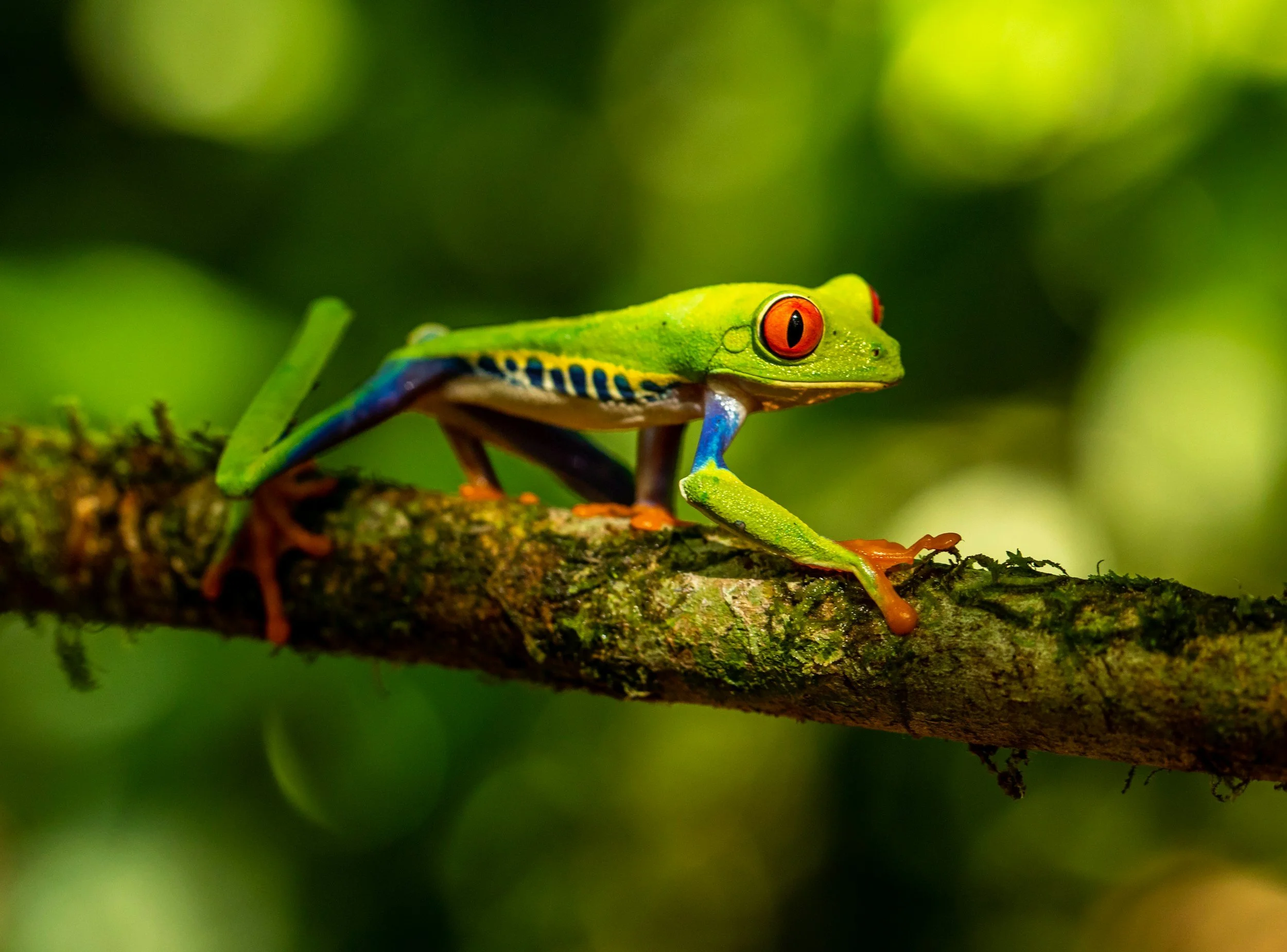
-
• Orientation — Vertical, front-opening with secure screen top and strong cross-ventilation.
• Size — Minimum 18×18×24" for one (or a small pair); add at least ~10 gal equivalent per additional frog; larger is better.
• Furnishing — Dense live/artificial plants, cork tubes, vines, and broad leaves placed high for sleeping; provide visual cover.
• Water — Keep a shallow, easy-to-exit dish; change daily and scrub weekly.
• No cohab with other species; groups of same species only (and only if you can maintain parameters).
-
• Photoperiod — ~12 h light / 12 h dark (seasonal shifts fine).
• UVB — Recommended at low level. Target ~UVI 0.5–1.0 at upper perches; provide full-shade retreats.
• Hardware — Low-output T5 (e.g., ShadeDweller/5.0 class) at correct distance; verify with a Solarmeter 6.5.
• Visible light — Bright, cool-running LEDs to grow plants and set day/night rhythm.
-
• Day ambient: ~72–78°F (22–26°C) with a warm leaf/perch ~84–85°F.
• Night: ~66–72°F (19–22°C) drop is normal.
• Humidity: Baseline ~60–70% with brief spikes up to ~100% right after misting; return to baseline within a couple hours.
• Method: Mist lightly morning and evening; rely on live plants + moist substrate layers for moisture, not a sealed box.
• Water type: Use dechlorinated tap or spring water for misting/dishes (no untreated tap; RO/distilled reserved for foggers).
-
• Substrate: Moisture-retentive, well-drained mix (e.g., ReptiSoil/coco + leaf litter); bioactive works well once dialed in.
• Layout: Tall cork, branching vines, broad leaves, and multiple elevated hides; leave open pathways to jump.
• Safety: No sharp edges; secure heavy décor; ensure easy exits from the water dish.
-
Staples
• Crickets, roaches, BSFL/flies, earthworms; occasional hornworms/silkworms. No wild-caught prey.
Schedule
• Juveniles: feed daily (small meals).
• Adults: feed every 2–3 days (what they’ll eat in ~10–15 min).
Supplements
• Dust insects with calcium and a broad multivitamin (incl. vit A & D3 per product) at conservative cadence; gut-load 24–48 h.
• If you provide correct UVB, use low-D3 dusts; if not, use products with D3 as directed.
• Remove leftovers promptly; tong-feed to control portions if needed.
-
• Hands-off species: observe rather than handle.
• If you must move the frog, use wet, powder-free nitrile/vinyl gloves and a deli cup; support gently.
• Expect startle jumps when lights come on—work at dusk and keep movements slow.
-
DAILY: Change water; remove waste/leftovers; quick temp/humidity check.
WEEKLY: Rinse mechanical filter media (if used) in tank water; wipe doors/panels; prune plants; refresh leaf litter as needed.
MONTHLY: Partial substrate refresh (or service bioactive); deep-clean dish/decor with amphibian-safe disinfectant.
-
Watch for: refusal to feed, lethargy, abnormal buoyancy/“soaking,” reddened skin (“red-leg”), abnormal sheds, bloat, ocular swelling, mouth lesions.
Immediate checks: verify water quality (if running water feature), temps/humidity, supplement cadence, and stress/over-handling.
Vet help: Amphibians decline quickly—seek an experienced exotics/ARAV vet for systemic signs or trauma.
-
• Trade: Listed on CITES Appendix II—check paperwork for international trade; prefer captive-bred.
• Public health: Amphibians can carry Salmonella—wash hands; keep out of kitchens; supervise children/high-risk people.
• Ethics: Never release captives outdoors.
-
□ Tall, front-opening terrarium (≥18×18×24") with secure screen
□ Low-level UVB (UVI ~0.5–1.0 at upper perches) + timer
□ Low-watt heat source to create ~84–85°F warm leaf (if room is cool)
□ Digital probe thermometers/hygrometers (×2) + IR temp gun
□ Dechlorinator; amphibian-safe disinfectant; mist bottle/fogger (on a humidistat if used)
□ Moisture-holding substrate (coco/ReptiSoil) + leaf litter; live/artificial plants; cork/vines
□ Shallow water dish (easy exit) + spare for swaps
□ Variety of live feeders; gut-load diet; calcium & multivitamin powders (per UVB use)
□ Nitrile/vinyl gloves; catch cup