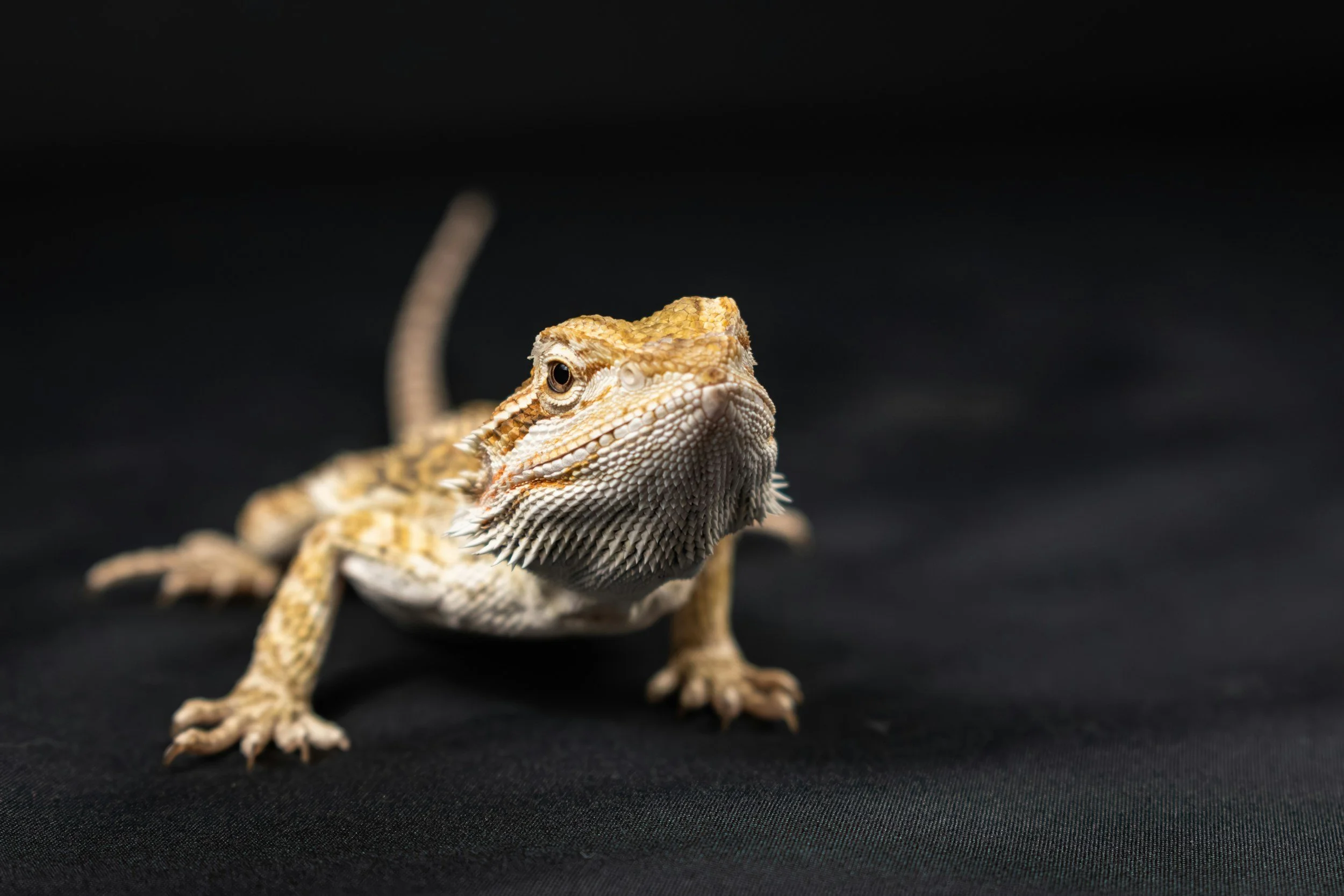
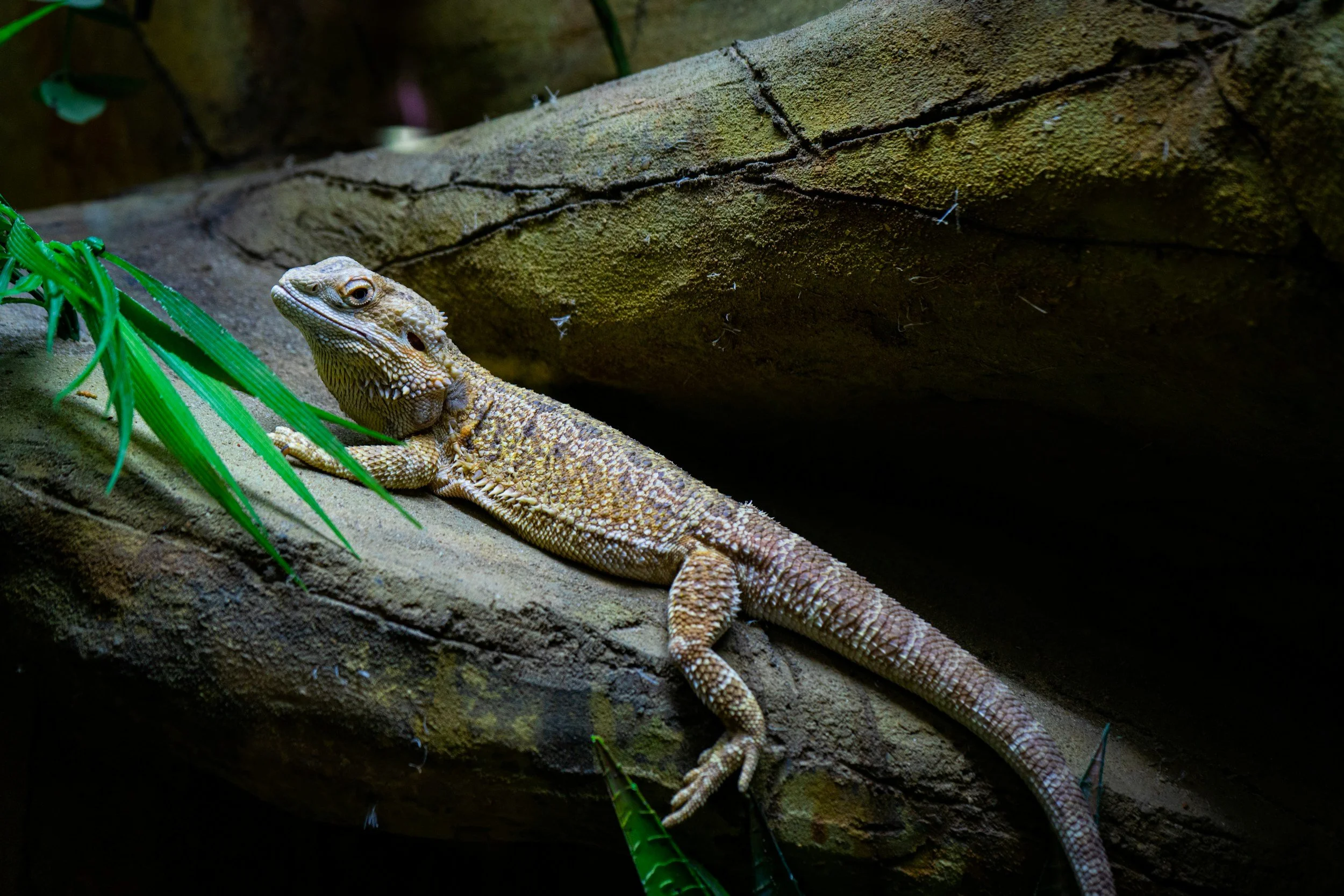
Beaded Dragon Pogona vitticeps
Updated: December 2025
QUICK FACTS
Common name: Bearded Dragon
Scientific: Pogona vitticeps
Type: Diurnal; arid/semi-arid; terrestrial (skilled climbers and enthusiastic burrowers)
Adult size: 18–24" total length
Lifespan: Average 10–15 years; 20–25 years possible
Adult enclosure: No smaller than 6’L × 2’W × 2’H (front-opening; good ventilation)
Cohab: Not recommended; keep only one per enclosure
UVB: 34" T5 HO Arcadia 12% or Zoo Med ReptiSun 10.0 (warm side)
UVB distance: Over mesh 11–13"; inside enclosure 16–19" (target UVI 4.0–6.0 at basking)
Daylight/brightness: Add ~6500K lighting; illuminate 75–100% of enclosure length
Temperature: Basking surface 105–115°F; cool zone 70–85°F
Humidity: Average 30–60% (probe on ground, cool side)
Substrate: Fine sand or sandy soil, packed at least 4" deep (preferably deeper)
Water: Shallow bowl of fresh water daily; bathing/soaking is unnecessary and not beneficial
Feeding: Hatchlings insects 2×/day + veg daily; juveniles insects 1×/day + veg daily; adults insects 2–3×/week + veg daily
Supplements: Calcium (no D3) + multivitamin (contains D3), or a good all-in-one per label
-
• Orientation - Horizontal, front-opening preferred; strong ventilation and secure latches.
• Size - Adult minimum 6’×2’×2’ (bigger is better).
• Cohab - Not recommended; one bearded dragon per enclosure (territorial/stress/injury risk).
• Basking Zone - Large, stable basking platform (flagstone/slate works well); cannot wobble or collapse.
• Hide/Cover - At least one secure hide (cool side) plus visual cover/structure so the habitat isn’t “open.”
• Layout - True gradient (hot basking → warm → cool) with room to move, explore, and retreat. -
• UVB Type — T5 HO desert UVB (Arcadia 12% or ReptiSun 10.0) on the warm/basking side.
• UVB Length — Use a long fixture (commonly ~34") so the basking zone is properly covered.
• UVB Distance — Over mesh: basking area ~11–13" below; mounted inside: ~16–19" below (adjust to your specific fixture/mesh).
• UVB Goal — Target UVI ~4.0–6.0 at basking (Solarmeter 6.5 is ideal for dialing this in).
• Daylight Brightness — Add 6500K bright white lighting to illuminate most of the enclosure (UVB is not the same as bright light).
• Photoperiod — Consistent day/night cycle (commonly ~12 hours).• Basking heat coverage — Often best achieved with at least two halogen bulbs side-by-side to create a wide basking zone.
-
• Basking Surface — 105–115°F (measure surface temp with an IR temp gun).
• Cool Zone — 70–85°F (digital probe thermometer on cool side).
• Heating Source — Halogen heat lamp preferred for basking; dimmer/rheostat for fine tuning.
• Night Temps — Lights off at night; only use non-light heat on a thermostat if your room drops too cold.
• Humidity — 30–60% average; measure near ground on the cool side with a probe.
• Ventilation — Good airflow prevents stagnant humidity and helps keep temps stable.• Humidity swings — Occasional spikes/dips outside 30–60% are fine; chronic >60% or <30% is the issue.
• Night temps — Night drops are normal; add supplemental heat only if your room gets very cold. -
• Best Practice — Fine sand / sandy soil that allows digging and natural movement.
• Depth — ≥4" packed (deeper is better).
• Options — Clean sand, commercial desert substrates, or a DIY mix (play sand + organic topsoil + excavator clay).
• Quarantine/Medical — Paper towels for sick/injured dragons or new arrivals you’re monitoring closely.
• Safety — Keep substrate dry; remove soiled areas promptly. -
• Goal — Not a sparse “box”; enrichment supports normal behavior and reduces stress.
• Climbing — Sturdy branches/logs and ledges; they do climb even though they’re terrestrial.
• Texture — Rocks, cork, textured background, varied surfaces for grip and interest.
• Cover — Plants (live or artificial) and structure for security.
• Stability — Anchor heavy décor so nothing can shift and injure the dragon. -
• Feeding (Hatchlings 0–3 mo) — Insects 1×/day; vegetables daily; calcium on all insects & salads; multivitamin on salads 2×/week.
• Feeding (Juveniles <12”/25cm) — 5–6 head-sized insects daily; vegetables daily (about 3× insect volume); calcium on all insects & salads; multivitamin on salads 2×/week.
• Feeding (Subadults/Adults >12”/25cm) — 3–4 head-sized insects 2×/week; vegetables 3×/week (portion ≈ size of dragon’s head); calcium on all insects & salads; multivitamin on salads 1×/week.
• Water — Provide a shallow water bowl; forced “bath” routines are not recommended (voluntary soaking is fine). -
• Daily — Spot-clean feces/urates; refresh water; quick check temps/UVB function.
• Weekly — Clean bowls; wipe down high-contact surfaces (doors/ledges); inspect décor stability.
• Substrate — Remove contaminated areas as needed; full replacement typically every 4–6 months (sooner if heavily soiled).
• Lighting/Heat — Replace UVB on schedule per manufacturer; check fixtures and cords routinely. -
• Acclimation — Limit handling until the dragon is eating reliably and acting normal.
• Handling — Support the whole body; short, calm sessions; avoid grabbing from above.
• Body Language — Dark beard, gaping, frantic glass-surfing, and repeated escape behavior often indicate stress or a husbandry issue.
• Routine — Consistency (lighting/temps/feeding schedule) improves behavior and appetite. -
• Vet-Now Signs — Persistent refusal to eat with weight loss, severe lethargy, repeated diarrhea, swelling, wounds/burns, wheezing/open-mouth breathing, tremors/weakness, deformities.
• First Checks — Confirm basking surface temp (105–115°F), UVB type/placement, supplement routine, and hydration access.
• Common Root Causes — Incorrect UVB or basking temps are frequent drivers of chronic problems. -
• Hygiene — Reptiles can carry Salmonella; wash hands after handling and keep reptiles away from food-prep areas.
• Heat Safety — Secure fixtures; prevent contact burns; verify temps with tools (not guesswork).
• Electrical Safety — Use timers/surge protection; keep cords dry and organized.
• Local Rules — Verify ownership/sales rules in your state/county if applicable. -
• Enclosure — 6’×2’×2’ front-opening enclosure; secure latches; strong ventilation.
• Heating — Halogen basking lamp + fixture; dimmer/rheostat; (optional) thermostat for any non-light heat.
• Measuring Tools — IR temp gun; digital probe thermometer/hygrometer.
• UVB — 34" T5 HO desert UVB + reflector fixture (Arcadia 12% / ReptiSun 10.0).
• Daylight — 6500K bright white lighting to light up most of the enclosure.
• Habitat — Packed sand/sandy soil (≥4"); hide; stable basking stone; branches/logs; plants/cover; bowls.
• Feeding — Feeder insect variety + gut-load; calcium (no D3); multivitamin (with D3) or all-in-one.